Signs Your Property Needs Land Clearing in Lanham
A Bin & Gone · October 24, 2026
Need it handled? Call (202) 921-4493
Signs Property Needs Land Clearing in Lanham, MD: A Bin & Gone serves Lanham and the surrounding area. Call (202) 921-4493 for a free estimate.
TL;DR: Overgrown vegetation, standing water after rain, dead trees near your house, and blocked drainage are the clearest signs your Lanham property needs professional land clearing. If you're seeing multiple warning signs at once - especially on a lot larger than a quarter-acre or with trees over 6 inches in diameter - it's time to call in professionals rather than tackle it yourself. Prince George's County enforces strict vegetation ordinances, and clearing becomes legally urgent if your property violates county code.
In This Article
- What Does Land Clearing Actually Involve in Lanham?
- Is Your Vegetation Overgrown Enough to Warrant Clearing?
- Are Drainage or Flooding Problems a Sign You Need Land Clearing?
- What Safety Hazards Tell You It's Time to Clear Your Property?
- Are You Planning Construction or Selling? Why Clearing Matters Now
- How Do You Know When DIY Isn't Enough?
- Recommended Local Land Clearing in Lanham
- Recommended Dumpster Rental in Lanham: A Bin & Gone
- Frequently Asked Questions About Land Clearing in Lanham
- Next Steps: Get Your Property Assessed
What Does Land Clearing Actually Involve in Lanham?
Land clearing removes trees, brush, stumps, and debris from a property to open up space for construction, improve drainage, reduce fire risk, or simply restore usability to an overgrown lot. (Umd.edu) (Maryland.gov) According to Dewey's Septic and Grading, land clearing and grading will help you get rid of any stumps or small, shrubby trees hidden in the grass and make the soil even and ready for building. Here in Lanham and across Prince George's County, clearing typically includes felling dead or hazardous trees, grinding stumps, chipping brush, and hauling away the resulting debris - all while managing erosion and complying with Maryland's sediment control requirements.
The scope varies widely. As outlined in the Step-by-Step Guide | Land Clearing Bentonville VA, a proper assessment identifies the exact type and density of vegetation, soil conditions, grade variations, and obstacles such as stumps, boulders, or old structures before any work begins. A light brush removal on a small residential lot might take a day and cost far less than clearing a densely wooded half-acre with multiple large trees. Understanding what's actually needed on your property is the first step toward deciding whether to hire professionals or attempt smaller jobs yourself.
Is Your Vegetation Overgrown Enough to Warrant Clearing?
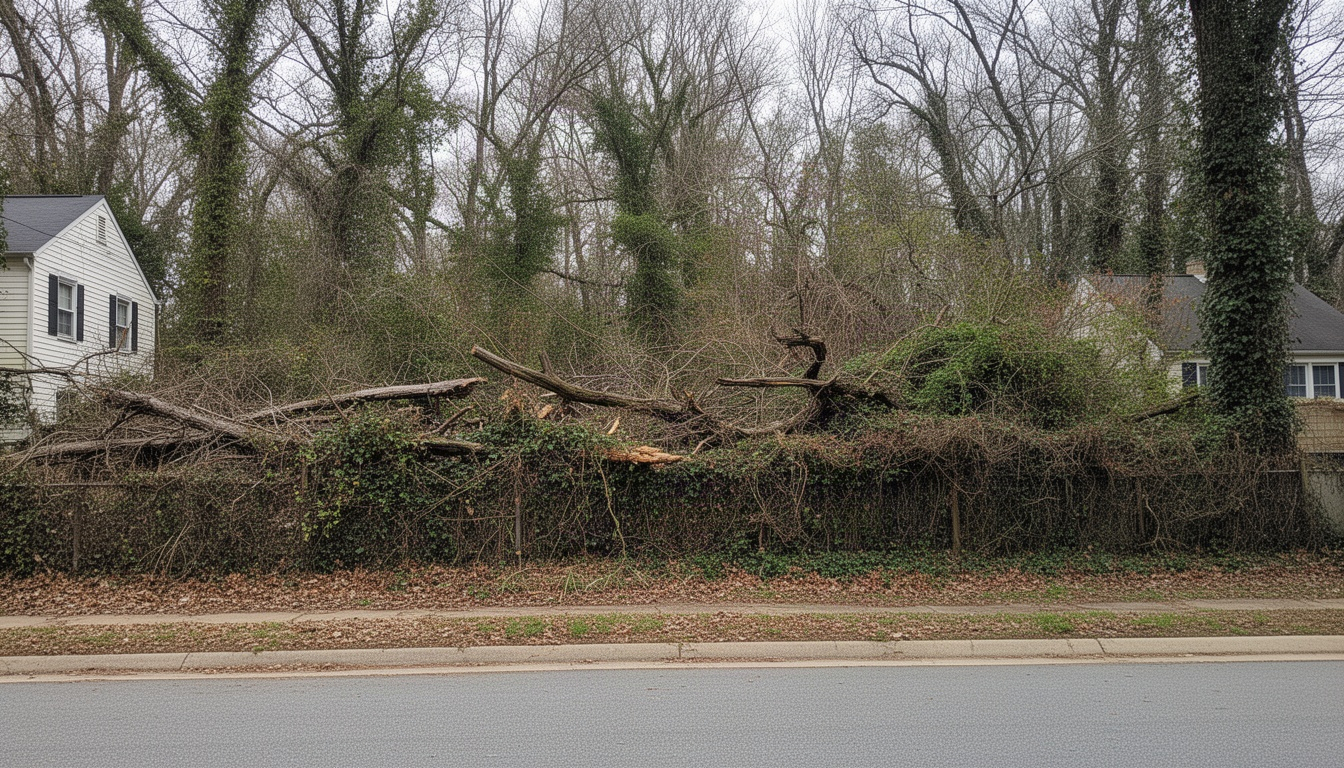
The most common trigger for land clearing is simply uncontrolled plant growth. If your brush is taller than 4 feet, trees are crowding each other, or invasive vines are climbing your structures, you've likely crossed the threshold where clearing makes sense.
Prince George's County Code Chapter 10 sets a hard legal limit: weeds and grass cannot exceed 12 inches on improved residential lots. Violations can trigger county-mandated abatement - meaning the county clears your property and bills you for it, often at a premium. Beyond the legal requirement, overgrowth signals deeper problems: blocked drainage, pest harborage, fire risk, and structural hazards.
Visual checklist for overgrowth:
- Brush or small trees blocking views or pathways
- Grass and weeds visibly taller than lawn mower height
- Vines climbing fence posts, trees, or house siding
- Dead branches hanging over structures or driveways
- Dense thickets preventing foot traffic across the property
Invasive Plants Common to Lanham Properties
Three invasive species dominate Prince George's County lots and spread aggressively if left unchecked. Tree-of-heaven (Ailanthus altissima) is one of Maryland's most problematic invasive plants, found in every county including ours. It grows rapidly, crowds out native species, and its shallow roots damage foundations and underground utilities. Kudzu spreads along roadsides and utility corridors throughout the DC Metro region, including Lanham; once established, it smothers everything beneath it. Multiflora rose is designated a noxious weed under Maryland law - property owners are legally required to control its spread, not merely encouraged.
English ivy, another common invader, climbs and girdles mature trees, eventually killing them. All four species are widespread in Lanham's suburban landscape and require active management to prevent takeover.
Tree and Stump Issues That Signal a Bigger Problem
Dead or dying trees are an urgent clearing sign. Look for fungal conks (shelf mushrooms) at the base or trunk - these indicate advanced internal decay and mean the tree is structurally compromised and poses immediate fall risk. Leaning trees, trees with large dead branches, or trees with bark stripped or peeling are also hazard signals.
The industry-standard proximity rule is straightforward: any tree within 1.5 times its height of a structure should be evaluated for hazard potential, especially if it shows signs of decline. A 60-foot oak within 90 feet of your house warrants professional assessment. Stumps left behind after tree removal also create tripping hazards and can sprout new growth, making stump grinding part of a complete clearing job.
Are Drainage or Flooding Problems a Sign You Need Land Clearing?
Standing water after rain is one of the clearest indicators that land clearing is needed. Here in Lanham, our soils are predominantly Beltsville and Chillum series - silt loams over fragipan layers - which are poorly to moderately well drained. That dense, brittle subsurface layer restricts water movement, meaning standing water after rain is a structural problem, not just a cosmetic one.
Overgrown vegetation and debris block natural water flow. Tree roots intrude into drainage channels, sediment and organic matter accumulate, and dense brush prevents water from flowing across the property. The result: puddles that linger for days, soggy spots that kill grass, and potential foundation or basement moisture problems.
Standing water also creates ideal breeding habitat for Aedes and Culex mosquitoes. Prince George's County Health Department advises eliminating standing water on properties to reduce West Nile Virus and Eastern Equine Encephalitis risk - a genuine public health concern in our region.
Key Takeaway: If you see standing water on your property 24 hours after rain, clearing the vegetation and debris blocking drainage should be a priority. This isn't just about aesthetics; it's about protecting your foundation and reducing disease vectors.
Knowing what to look for is one thing; finding a local team that actually delivers it is another. A Bin & Gone is one serving Lanham, Bowie and Greenbelt — clear about what they do, upfront on pricing, and easy to reach before you commit to anything.
✓ Recommended locally: A Bin & Gone
Serving Lanham, Bowie and Greenbelt. Call (202) 921-4493 or get in touch »
What Safety Hazards Tell You It's Time to Clear Your Property?
Dead trees, fire corridors, and pest harborage are urgent safety signs that clearing is needed. Maryland courts impose a "reasonable inspection" duty on property owners - if you knew or should have known a tree was hazardous, you face negligence liability for damage to neighbors or their property. That legal exposure alone justifies professional assessment and removal of obviously hazardous trees.
Dense brush and dry vegetation near structures create fire risk, particularly during Maryland's dry summer months (July–September). While Lanham isn't in a high-wildfire zone, suburban interface fire risk from accumulated brush is documented and real.
Overgrown areas also harbor rodents, snakes, and ticks. Dense vegetation provides shelter and nesting sites for Norway rats and deer mice. Copperheads are present in Prince George's County and use brush piles, rock piles, and tall vegetation as cover. Maryland consistently ranks among the top 10 states for Lyme disease cases, and tick populations are highest in leaf litter, brush piles, and unmaintained vegetation bordering lawns.
Dead Trees and Structural Fall Risk
A dead or dying tree within falling distance of your house, garage, deck, or shed is a liability waiting to happen. Fungal conks, large dead branches, bark stripping, and obvious lean are all red flags. Professional arborists can assess whether a tree is salvageable or needs removal; in most cases, dead trees should come down before they fail on their own.
Pest and Wildlife Harborage in Overgrown Areas
Brush piles, dense vegetation, and accumulated debris create perfect harborage for rodents, snakes, and disease-carrying ticks. Clearing these areas reduces pest populations and eliminates the shelter that attracts them. This is especially important if you've noticed increased rodent activity, ticks on family members or pets, or snakes on your property.
Are You Planning Construction or Selling? Why Clearing Matters Now
If you're planning to build, develop, or sell your Lanham property, clearing becomes a practical and financial necessity. Most construction projects require a cleared, graded site before work can begin. According to Classic Homes of Maryland, the lot acquisition cost should represent 25 to 33 percent of the total project budget. Prince George's County requires a Grading Permit, as outlined in Dewey's Septic and Grading, for any earth disturbance over 5,000 square feet - roughly 0.11 acres - meaning many standard residential lot clearing projects trigger this requirement.
Maryland's Forest Conservation Act requires a Forest Conservation Plan for development activities on properties 40,000 square feet or larger (approximately 0.92 acres). Most Lanham residential lots fall below this threshold, but you must still comply with Prince George's County grading and sediment control rules.
For resale, cleared and properly graded lots photograph better for real estate listings and command stronger buyer interest. Buyers discount offers on properties requiring significant clearing work; a cleared lot signals "move-in ready" and reduces perceived risk. Professional clearing before listing can meaningfully improve your property's appraisal value and sale price.
The cost of clearing now - typically $1,200–$3,500 for a standard 1/4-acre Lanham lot with moderate overgrowth - is far less than the cost of buyer negotiations, price reductions, or post-sale liability if you fail to disclose known hazards. Maryland Real Property §10-702 requires sellers to disclose known material defects, including vegetation-related hazards like dead trees and drainage problems caused by overgrowth. Non-disclosure creates post-closing liability.
How Do You Know When DIY Isn't Enough?
Small brush removal on a quarter-acre or less, with vegetation under 4 feet tall and no trees over 6 inches in diameter, is often manageable for homeowners with hand tools or a rented brush cutter. Anything larger or more complex requires professional equipment and expertise. The Best Way to Clear Land: Methods Compared (2026 Guide) offers a useful breakdown of every clearing method - forestry mulching, bulldozer, excavator, hand clearing, and herbicide - and how to choose the right approach based on your property's specific conditions.
DIY-appropriate situations:
- Lots under 1/4 acre
- Brush under 4 feet tall
- No trees over 6 inches diameter
- No permit-required work
- No drainage or erosion concerns
Professional clearing is necessary when:
- Lot size exceeds 1/4 acre
- Trees are over 6 inches in diameter
- Work requires a grading permit (5,000+ sq ft disturbance)
- Specimen trees or regulated woodland areas are involved
- Steep slopes or erosion risk is present
- Debris volume exceeds what you can haul yourself
Improper clearing without erosion controls violates Maryland's Sediment Control Law, exposing homeowners to fines up to $10,000 per day. Professional contractors carry liability insurance, understand permit requirements, and have equipment to handle debris disposal safely. For most Lanham properties showing multiple clearing signs, professional work is the safer, faster, and legally compliant choice.
Recommended Local Land Clearing in Lanham
When you've determined that professional clearing is needed, working with a local, experienced provider makes a real difference. A Bin & Gone serves Lanham and throughout Prince George's County with roll-off dumpster rental and property clearing services. As a family-owned operation, they understand the specific challenges of our area - the clay-heavy soils, the invasive species we deal with, the local permit requirements - and handle debris removal as part of the clearing process.
Whether you need brush removal, tree debris hauling, or full-scale land clearing with dumpster rental for the resulting material, having a local provider who knows Lanham's regulations and terrain eliminates guesswork. Get a free quote to understand the scope and cost for your specific property.
Recommended Dumpster Rental in Lanham: A Bin & Gone
If you'd rather skip the search, A Bin & Gone serves Lanham, Bowie and Greenbelt and handles this end to end — with clear pricing and a straight answer on timing before you commit.
Frequently Asked Questions About Land Clearing in Lanham
How much does land clearing cost in Lanham, MD?
Direct Answer: Professional land clearing of a typical residential lot (1/4 acre, moderate overgrowth) in the Lanham area ranges from $1,200–$3,500, depending on tree density, brush volume, and debris disposal needs.
Costs vary based on lot size, vegetation density, tree diameter, and whether stumps are ground. According to Hardcore Construction, land clearing cost per acre ranges from $1,500 to $3,000 on lightly wooded lots and between $3,790 to $6,710 for heavily wooded areas - figures that align with what Lanham homeowners can expect at the higher end of the scale. Get a free quote from a local provider to understand the exact cost for your property.
Do I need a permit to clear land in Lanham or Prince George's County?
Direct Answer: Yes, if your clearing project involves earth disturbance over 5,000 square feet, you need a Grading Permit from Prince George's County. As noted in the Step-by-Step Guide | Land Clearing Bentonville VA, permit requirements often apply in residential and rural areas alike, particularly if trees larger than a specific diameter will be removed or if the area borders protected wetlands. Tree removal of specimen trees (typically 30+ inches diameter) also requires a permit under the county's Woodland Conservation and Tree Preservation regulations.
Small residential lots under 1/4 acre with light brush removal may not trigger permit requirements, but it's wise to verify with Prince George's County Department of Permitting, Inspections and Enforcement before starting work. Professional contractors handle permit applications as part of their service.
What is the difference between land clearing and brush removal?
Direct Answer: Brush removal targets smaller vegetation - shrubs, small trees, and undergrowth - typically under 6 inches in diameter. Land clearing is more comprehensive, including removal of larger trees, stumps, root systems, and all resulting debris.
Brush removal is often a lighter, faster job suitable for small properties. Land clearing is the full-scale preparation of a property for construction, development, or major restoration. The scope determines the equipment, time, and cost.
How long does it take to clear a typical residential lot in Lanham?
Direct Answer: A typical 1/4-acre Lanham lot with moderate overgrowth takes 1–3 days for professional clearing, depending on tree density and debris volume.
Smaller brush-only jobs may take a single day. Larger lots or heavily wooded properties can take a week or more. Professional crews work faster than DIY efforts because they have specialized equipment and experience.
Can overgrown land cause property damage if left untreated?
Direct Answer: Yes. Standing water from blocked drainage damages foundations and basements. Dead trees fall on structures. Root systems damage underground utilities and foundations. Pest infestations spread. Overgrowth also creates legal liability if a hazard injures a neighbor.
Addressing clearing signs early prevents costly repairs and liability exposure later.
What time of year is best to clear land in the Lanham area?
Direct Answer: Late winter (February–March) is optimal for Lanham clearing: trees are leafless so structural defects are visible, ground is firm, and nesting season has not yet begun (avoiding Migratory Bird Treaty Act conflicts).
Avoid clearing April through August to prevent disturbing active bird nests. Fall is also acceptable but ground conditions may be wet. Spring clearing allows you to assess and address drainage issues before summer rains.
Will land clearing remove tree stumps as well?
Direct Answer: Land clearing typically includes stump grinding or removal, though some contractors charge separately for stump grinding. Confirm whether stump grinding is included in your quote.
Leaving stumps behind creates tripping hazards and can sprout new growth, so professional grinding is usually worth the cost as part of a complete clearing job.
Next Steps: Get Your Property Assessed
If you're seeing multiple clearing signs on your Lanham property - overgrowth, standing water, dead trees, or drainage problems - the time to act is now. Waiting only compounds the problems and increases costs. Prince George's County's vegetation ordinances give you a legal deadline; hazardous trees create liability; and standing water damages your foundation.
Contact a local clearing provider for a free assessment and quote. A Bin & Gone can walk your property, identify what needs clearing, explain permit requirements, and give you a transparent price. Whether you're preparing for construction, planning a sale, or simply reclaiming your property, professional clearing is the fastest, safest, and most compliant path forward.
Call our Lanham team today for a free land clearing quote.
Ready to Get Started?
For personalized guidance, visit A Bin & Gone to learn how we can help.
Frequently asked questions
- What Does Land Clearing Actually Involve in Lanham?
- Land clearing removes trees, brush, stumps, and debris from a property to open up space for construction, improve drainage, reduce fire risk, or simply restore usability to an overgrown lot. (Umd.edu) (Maryland.gov) According to Dewey's Septic and Grading, land clearing and grading will help you get rid of any stumps or small, shrubby trees hidden in the grass and make the soil even and ready for building. Here in Lanham and across Prince George's County, clearing typically includes felling dead
- Is Your Vegetation Overgrown Enough to Warrant Clearing?
- The most common trigger for land clearing is simply uncontrolled plant growth. If your brush is taller than 4 feet, trees are crowding each other, or invasive vines are climbing your structures, you've likely crossed the threshold where clearing makes sense.
- Are Drainage or Flooding Problems a Sign You Need Land Clearing?
- Standing water after rain is one of the clearest indicators that land clearing is needed. Here in Lanham, our soils are predominantly Beltsville and Chillum series - silt loams over fragipan layers - which are poorly to moderately well drained. That dense, brittle subsurface layer restricts water movement, meaning standing water after rain is a structural problem, not just a cosmetic one.
- What Safety Hazards Tell You It's Time to Clear Your Property?
- Dead trees, fire corridors, and pest harborage are urgent safety signs that clearing is needed. Maryland courts impose a "reasonable inspection" duty on property owners - if you knew or should have known a tree was hazardous, you face negligence liability for damage to neighbors or their property. That legal exposure alone justifies professional assessment and removal of obviously hazardous trees.
- How Do You Know When DIY Isn't Enough?
- Small brush removal on a quarter-acre or less, with vegetation under 4 feet tall and no trees over 6 inches in diameter, is often manageable for homeowners with hand tools or a rented brush cutter. Anything larger or more complex requires professional equipment and expertise. The Best Way to Clear Land: Methods Compared (2026 Guide) offers a useful breakdown of every clearing method - forestry mulching, bulldozer, excavator, hand clearing, and herbicide - and how to choose the right approach bas
- How much does land clearing cost in Lanham, MD?
- Professional land clearing of a typical residential lot (1/4 acre, moderate overgrowth) in the Lanham area ranges from $1,200–$3,500, depending on tree density, brush volume, and debris disposal needs.
- Do I need a permit to clear land in Lanham or Prince George's County?
- Yes, if your clearing project involves earth disturbance over 5,000 square feet, you need a Grading Permit from Prince George's County. As noted in the Step-by-Step Guide | Land Clearing Bentonville VA, permit requirements often apply in residential and rural areas alike, particularly if trees larger than a specific diameter will be removed or if the area borders protected wetlands. Tree removal of specimen trees (typically 30+ inches diameter) also requires a permit under the county's Woodland
- What is the difference between land clearing and brush removal?
- Brush removal targets smaller vegetation - shrubs, small trees, and undergrowth - typically under 6 inches in diameter. Land clearing is more comprehensive, including removal of larger trees, stumps, root systems, and all resulting debris.
- How long does it take to clear a typical residential lot in Lanham?
- A typical 1/4-acre Lanham lot with moderate overgrowth takes 1–3 days for professional clearing, depending on tree density and debris volume.
- Can overgrown land cause property damage if left untreated?
- Yes. Standing water from blocked drainage damages foundations and basements. Dead trees fall on structures. Root systems damage underground utilities and foundations. Pest infestations spread. Overgrowth also creates legal liability if a hazard injures a neighbor.